Friday, July 25, 2025

Ecosuite - Distributed Energy Accelerated

It's been a while, but if you are here reading this blog, then you likely need to know about Ecosuite!  Ecosuite is new as of early last year and thanks to our amazing team and specifically our deep long held vision and approach, progress has been rapid.

In short, Ecosuite is distributed energy SaaS that kicks.

Leveraging open source (yes, SolarNetwork is under the covers) and strategically placed AI, Ecosuite eliminates traditional friction points from your day.  The marketing department might say that it offers services that empowers teams to finance, plan, deploy, monetise and operate heterogeneous distributed energy assets at scale.  But it's more than this, much more.  Don't take my word for it, book a demo to see it first hand. If you and your team have pain points that you want to solve, you need to see this.

For some clarity on what Ecosuite is and where it fits in the market, other products and companies in this space include: Stem, Also Energy, Power Factors, QBI Solutions, Banyan Infrastructure, Radian Generation etc.  Because Ecosuite also offers rich powerful APIs for data scientists and solution integrators alike, API only companies like Texture HQ should also be considered in this list (noting that more API options is a good thing, we need all resources when it comes to busting silos and opening up data access).  This lens on more being better is almost always true at any level within a market, everyone needs to explore their options and make their choice, making sure that the best choice for their needs is selected.  In a landscape of heterogeneous products and services, it would be wise to choose a solution that accepts this reality and works with you, as opposed to solutions that might attempt to build a proprietary walled garden with your data and your assets inside.

No matter how you look at things, efficiency and flexibility is key and eliminating waste is going to be essential in 2025 and beyond (soft costs anyone?).  It's exciting times ahead for the industry and the tools that we leverage, everyone needs to take a big step forward.

Ecosuite.io

In this respect, I believe Ecosuite's approach is deeper, broader, more open and rigorous than what has come before.  There is something new about this and the DER industry needs to see it.  Definitely check it out!

Friday, December 31, 2021

USA

 As some of you will be aware, the core Greenstage Power team (Max, Matt, John and Philip) have been working with Ecogy Energy a New York based company for a little while now.  For all intents and purposes the Greenstage Power team is now Ecogy Energy and all new distributed energy projects will be carried out under this banner.  With Ecogy Energy we have stepped up our ability to accelerate the global transition to renewable energy, we are using Solar PV and other Distributed Energy Resources (DER) to transform the grid.  One of our distinguishing features is the use of open source software coupled with proprietary role-based user experiences and business process layers to optimise this whole space.  Not only are we providing enhanced user experiences to our customers and our internal team, but we are working to open up opportunities for all parties via advances in the state of the art open source thinking for grid facing services in particular.
The need and the opportunity in this space is massive.  Most apparent is the need for smart open solutions and tools that will let the industry as a whole move forwards in a productive, secure and efficient manner to unlock the true value in providing dynamic DER services to the grid.

Existing customers in New Zealand are still being serviced via Greenstage Power and you can continue to leverage your existing contact points for any on-going business needs.  Just be aware that anything that looks like a less active presence in New Zealand is due to our focus on the US market and our on-going efforts with colleagues in New York and across the US as we work to accelerate the decarbonisation of global electricity grids.

Greenstage Power is a spin off from Greenstage Investments Ltd (Greenstage).  It shows what is possible with a clear positive vision of the future, combined with persistence, smarts and identifying the right partners.  Greenstage continues to offer services for future-focused business ideas and electric vehicle innovation.  We have an updated website coming soon to reflect and communicate this more clearly. Please contact Stephen Morgan on +64 221972074 for any new or on-going enquiries.

Tuesday, April 14, 2020

The great pause - Pondering empowerment post Corona virus lockdown

During this pause in the human experiment of infinite growth on a finite planet, we all have time to ponder.  Questions like, how should we empower society as we emerge from the corona virus lockdown and what sort of benefits might we expect and hope for from this empowerment?

Something to hope for or just an interesting picture?
Airspeeder motorsport - a mixture of science fiction and gaming
Let's take a moment to further explore empowerment of individuals, how might we do this and what results might we expect.  There are already some pretty well understood candidates (and logically it seems many have self reinforcing aspects for the goal at hand), here are some good examples:
  • UBI providing individual freedom and hence more room for creativity
  • Free Education to degree level, hence encouraging and satisfying a thirst for knowledge
  • Government using and encouraging Open Source and Open Data
  • Prioritise walking and cycling, hence improving health, fitness, mobility, community connections and happiness
Plus, what if we combine these with wise long term environmental and economic goals (doughnut economics style):
With this new world fully embraced, what might this look like over time:
  • A healthy environment in balance with human society?
  • Increased local capabilities and resilience?
  • Increased time for important stuff like friends and family?
  • High levels of innovation and hence productivity?
  • Increased focus on digital tourism and digital sports events (e.g. where digital experience is the product, think visually realistic and physically active esports, think virtual spectator mixed with photo realistic virtual experiences extrapolated to tourism and new high tech sporting areas)?
  • Increased reverence for nature and the outdoors (where international tourism for pure physical outdoor experiences becomes a premium highly sought after product)?
  • Increasingly complex and interconnected local society (more holistic)?
  • A more equal society?
  • Increasing richness in art and culture?
  • Increased general interest in wondering about life, the universe and our place in it?
  • People are energized and alive with tangible opportunities to participate and thrive in society?
  • A society that treats Earth as our valued and cherished home, but increasingly looks beyond our home planet for the future?
I'll leave you to ponder these questions or to create your own list of thoughts and ideas.  Either way, I'm sure you will continue to make good use of your very own and very valuable corona-induced dilated time bubble.

Friday, September 6, 2019

India

India is currently in a massive government lead push to transition much of its transportation fleet to electric vehicles.

iXEnergy, an innovative New Delhi based company have been pushing ahead with their own EV and hybrid vehicle technology development plans.  Just this week gone the iXEnergy team have completed hybrid bus commissioning for their second OEM customer.  Well done to all the team!

Chris and the iXEnergy team
Greenstage and ScottDrive are proud to be supporting iXEnergy on this journey.  Every little bit helps as India and the world transitions towards a cleaner and more economic transportation fleet.  Well done to everyone involved and keep up the good work.

Sunday, August 5, 2018

Commentary on Electric Vehicle adoption in NZ

Price is no longer a barrier to electric vehicle (EV) adoption.  In fact, in New Zealand I would argue that price is now a driver for EV adoption if you are willing to look at the numbers.

For city driving, it now makes obvious sense to replace your petrol powered vehicle with an EV.  If you are driving a petrol powered car an average of 70 km per day, 6 days a week, then depending on your vehicle's fuel efficiency, its easy to be spending $50-100 per week on gas (in NZ petrol is currently around $2.30 per litre).

As well as this obvious saving, you will also be saving the wasted time and effort of going to a service station each week when the petrol tank needs topping up (with an EV, you just top up at home each night).

With some second hand EV's from Japan now available for less than $NZ 10,000, savings on petrol can very quickly pay this back (I'll let you do the sums).  Plus if you are buying this EV instead of an equivalent petrol powered car, the savings are immediate.

EV - no need for weekly visits to the service station.
Driving without the concern for the high cost of fuel, driving without the concern for the stinky butt smoke emanating from the rear of your car, driving without the concern of the upcoming or overdue oil change!!? A return to driving just for the fun of it, what's not to like.

Thursday, February 15, 2018

Testing the generic Modbus Device plugin

One of the cool plugins recently being tested for SolarNode is called "Modbus Device", it allows admins to add new hardware that supports the Modbus RTU and TCP protocols. Check out this link that describes using the Modbus Device plugin to talk to a thermopile pyranometer.  It's a pretty quick and easy process in terms of supporting a new industrial scientific instrument.

Pyranometer - measures irradiance (W/m2)
We see this device as extremely relevant to tracking solar array performance. Knowing quantitatively how a pyranometer is measuring sunlight near a PV array means that you have a metric for what you should expect from the array in terms of kilowatt-hours (kWh) generated. We expect to be able to use these irradiance figures as an input to SolarQuant (our non-linear energy data analysis engine) and then to inform admins as to whether actual performance is stacking up.  That means extracting more value from your solar array!

Automating this process is what is going to count - check back here for an update on SolarQuant development, there are more interesting developments coming up soon....

Tuesday, October 24, 2017

SolarQuant gets a push forward from University of Auckland

One of the exciting developments at Greenstage Power has been some collaboration with University of Auckland on our experimental machine learning module called SolarQuant. This is the stand alone app server that takes consumption or generation data and aims to learn how that energy flow happened, based on the context of when it happened and what the environmental conditions were at the time. We had a visitor to New Zealand from MIT Engineering named Paige Studer, and she was instrumental at giving SolarQuant a push forward. We interviewed Paige below on the project:


Tell us a little about what you worked on at UofA
During my time at the University of Auckland, I had the privilege to work on SolarQuant, which is a program that is working to accurately predict a building’s energy consumption given a set of inputs such as time, weather, temperature, etc. When I arrived at the UofA, the current state was that SolarQuant could take inputs and a building’s energy consumption to find weights for each of the inputs. Then given only the inputs and found weights, it would map how closely the calculated energy consumption matched the actually energy consumption. The next step was to see if we could get similar results by taking predicted inputs, getting a calculated energy consumption, and compare it with the actual inputs with actual consumption.
One of the main factors in being able to do this was formatting the predicted weather so that it looked the same as the actual weather, with the exception of a type id showing that it was predicted and not actual. The predicted weather was taken from Norwegian weather, in the form of an XML file. The program would go through the file and find entries that had all of the information that we needed and added them to an initial array. This array with the predicted weather data had problems, such as not being sorted, having repeating information, etc. This initial array needed to be cleaned up and adjusted to make it look like real data. A second array was constructed so that the time of each prediction was in chronological order and separated by thirty minutes, without any repeating or missing times. Once this was completed, the program would go through that array, create weather datum objects and place those objects into a database to be used in the future.
Because the future weather in the database looked the same as actual weather in the database, we could use it on the SolarQuant platform. From here the program takes the future weather data, downloads it, and instead of training it on energy consumption, it skips straight to the questioning stage since it is the future there is no energy consumption to train off of. After this, John was going to add his code and we would hopefully see predicted energy consumption and eventually compare this with actual energy consumption for the same time period.
Do you think it will work?
Yes, of course I think it will work! Theoretically it will, so if it doesn’t right away it would be due to some bugs in the code that can be fixed. I’m very excited to see where it goes in the future once it is working, because there are some pretty cool applications. One in particular that I find to be interesting is if we can accurately predict the weather and a building’s energy consumption, given a solar/battery system, you could potentially become smarter at when to charge and discharge your battery.
As a developer what are the challenges SolarQuant is going to have – what should we get ready for?
I think that SolarQuant will only be getting better and faster, and that it will be important to stay flexible and be able to adjust with the program. For instance, one thing that John and I had talked about was possibly using a different weather source for predicted weather and how to handle it. Do you make one function that can handle all different weather sources, make a function for each weather source, etc? Being open to change in the code and sources in the future will make a difference in how well SolarQuant will continue to progress. I think one idea that John reiterated that was helpful is we want to walk before we run, meaning let’s make small additions/changes and make sure that works before progressing. We don’t want to write all this code and have it not work without us knowing why.
Did you like NZ? We heard you went bungy jumping!?
New Zealand was absolutely awesome! I loved meeting new people, learning about the Maori culture, and especially loved the adventure atmosphere of New Zealand. On the weekends I was able to go on lots of side trips, my favorite being Queenstown where I did the Kawarau Bridge bungy jump, Waitomo black water rafting, and sand boarding while I was visiting the Bay of Islands.
What are the next plans, where to?
I will begin working at a solar energy company in Southern California that specializes in getting schools solar energy, often in the form of carports. I will be an Assistant Project Engineer there, and I hope to learn more about solar energy projects, continue to grow my skillsets, and make a positive impact on the community.

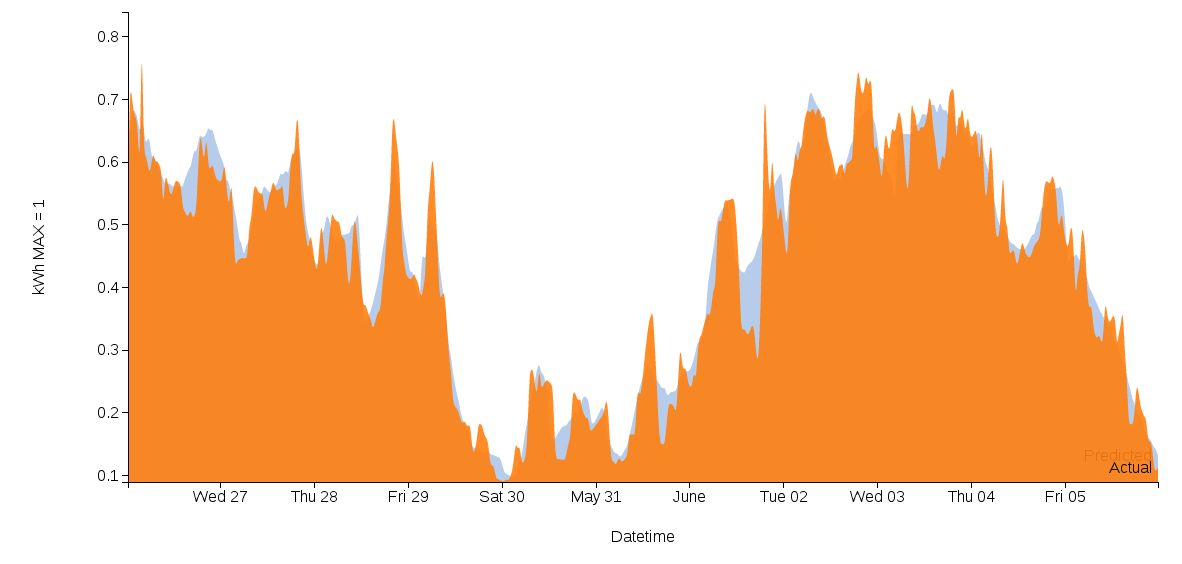
SolarQuant comparing predicted consumption (blue) with actual (orange) consumption after training on 1 year of data

Some of the results from Paige's work coming in are shown above in a screenshot of the SolarQuant interface. The trained network predicted a time series in light blue here, and the actual power consumption is shown in orange. Thanks once again to Dr. Nirmal Nair at University of Auckland ECE who made this possible! And developers can checkout SolarQuant as it progresses here: git@github.com:SolarNetwork/solarquant.git

Sunday, May 28, 2017

FreeBSD with Poudriere on ZFS with custom compiler toolchain

The SolarNetwork main infrastructure has always run on FreeBSD. FreeBSD is great for allowing packages to be built with options suited to how you want to use it, by building packages from source via the ports tree. FreeBSD has evolved over the years since SolarNetwork started to distributing binary packages via the pkg tool. That can save a lot of time, not having to compile all the software used from source, but doesn't work if some package needs a different set of compiled-in options than provided by FreeBSD itself. Additionally, I'd been compiling the packages using a specific version of Clang/LLVM rather than the one used by FreeBSD (originally because one package wouldn't compile without a newer compiler version than used by FreeBSD).

Fast forward to now, and FreeBSD has a tool called poudriere, which can compile a set of packages with exactly the options needed and publish them as a FreeBSD package repository, from which any FreeBSD machine can then use to download the binary packages from and install them via pkg. It's a bit like starting your own Linux distro, picking just the software and compile options you need and distributing them as pre-built binary packages.

Finally I took the time to set up a FreeBSD build machine running poudriere (in a virtual machine) and can much more easily perform updates on the SolarNetwork infrastructure. There was just one major stumbling block along the way: I didn't know how to get pourdriere to use the specific version of Clang I needed. There is plenty of information online about setting up poudriere, but I wasn't able to find information online about getting it to use a custom compiler toolchain. After some trial and error, here's how I finally ended up accomplishing it:

Create toolchain package repository

Poudriere works with FreeBSD jails to manage package repositories. Each package distribution uses its own jail with its own configuration such as what compiler options to use and which packages to compile. The first task is to create a package repository with the toolchain packages needed, in my case this is provided by the devel/llvm39 package. This toolchain repository can then be installed in other poudriere build jails to serve as their compiler.

Once poudriere was installed and configured properly, the steps looked like this:

# Create jail
poudriere jail -c -j toolchain_103x64 -v 10.3-RELEASE
mkdir /usr/local/etc/poudriere.d/toolchain_103x64-options

# Create port list (for this jail, just the toolchain needed, devel/llvm39)
echo 'devel/llvm39' >/usr/local/etc/poudriere.d/toolchain-port-list

# Update to latest (each time build)
poudriere jail -u -j toolchain_103x64
poudriere ports -u -p HEAD

# Configure options
poudriere options -j toolchain_103x64 -p HEAD \
    -f /usr/local/etc/poudriere.d/toolchain-port-list

# Build packages
poudriere bulk -j toolchain_103x64 -p HEAD \
    -f /usr/local/etc/poudriere.d/toolchain-port-list

After quite some time (llvm takes a terribly long time to compile!) the toolchain packages were built and I had nginx configured to serve them up via HTTP.

Create target system package repository

Now it was time to build the packages for a specific target system. In this case I am using the example of building a Postgres 9.6 based database server system, but the steps are the same for any system.

First, I created the system's poudriere jail:

# Create jail
poudriere jail -c -j postgres96_103x64 -v 10.3-RELEASE

# Create port list for packages needed
echo 'databases/postgresql96-server' \
    >/usr/local/etc/poudriere.d/postgres96-port-list

echo 'databases/postgresql96-contrib' \
    >>/usr/local/etc/poudriere.d/postgres96-port-list

echo 'databases/postgresql-plv8js' \
    >>/usr/local/etc/poudriere.d/postgres96-port-list

# Configure options
poudriere options -j postgres96 -p HEAD \
    -f /usr/local/etc/poudriere.d/postgres96-port-list

Second, install the llvm39 toolchain, using the custom toolchain repository:

# chroot into the build jail
chroot /usr/local/poudriere/jails/postgres96_103x64

# enable dns resolution for the build server (if DNS names to be used)
echo 'nameserver 192.168.1.1' > /etc/resolv.conf

# Copy /usr/local/etc/ssl/certs/poudriere.cert from HOST
# to /usr/local/etc/ssl/certs/poudriere.cert in JAIL
mkdir -p /usr/local/etc/ssl/certs
# manually copy poudriere.cert here

Then I configured pkg to use the toolchain repository via a /usr/local/etc/pkg/repos/poudriere.conf file:

poudriere: {
    url: "http://poudriere/packages/toolchain_103x64-HEAD/",
    mirror_type: "http",
    signature_type: "pubkey",
    pubkey: "/usr/local/etc/ssl/certs/poudriere.cert",
    enabled: yes,
    priority: 100
}

The URL in this configuration resolves to the directory where poudriere build the packages, served by nginx. Next I installed the toolchain, explicitly telling pkg to use this repository:

pkg update
pkg install -r poudriere llvm39

# clean up and exit the chroot
rm /etc/resolv.conf
exit

Now I can configure poudriere to use the toolchain by creating a /usr/local/etc/poudriere.d/postgres96_103x64-make.conf file with content like this:

# Use clang
CC=clang39
CXX=clang++39
CPP=clang-cpp39

DEFAULT_VERSIONS+=pgsql=9.6 ssl=openssl

The next step is what took me the longest to figure out, probably because I had not studied how poudriere works with ZFS very carefully. It turns out poudriere makes a snapshot of the jail named clean, and then clones that snapshot each time it performs a build. So all I needed to do was re-create that snapshot:
 
# Recreate snapshot for build
zfs destroy zpoud/poudriere/jails/postgres96_103x64@clean
zfs snapshot zpoud/poudriere/jails/postgres96_103x64@clean

Finally, the build can begin normally, and the custom toolchain will be used:

# Build packages
poudriere bulk -j postgres96_103x64 -p HEAD \
    -f /usr/local/etc/poudriere.d/postgres96-port-list

Update target system to use poudriere repository

Once the system's build is complete, it is possible to configure pkg on that system to use the toolchain repository via a /usr/local/etc/pkg/repos/poudriere.conf file:

poudriere: {
    url: "http://poudriere/packages/postgres96_103x64-HEAD/",
    mirror_type: "http",
    signature_type: "pubkey",
    pubkey: "/usr/local/etc/ssl/certs/poudriere.cert",
    enabled: yes,
    priority: 100
}

Then I copied the certificate from the build host to the file as configured above. I no longer want to use the default FreeBSD packages on this system, so I created a /usr/local/etc/pkg/repos/freebsd.conf file to disable it, with the following content:

FreeBSD: {
    enabled: no
}

Done! Now, after running pkg update, all packages will install from the poudriere repository, and I no longer need to compile the software on the system itself.

Friday, May 26, 2017

VivaTech 2017

This year Greenstage will be at VivaTech in France from June 15th to 17th.  We will be sharing our distributed energy solutions with the world and showing off our latest and greatest R&D.

Viva Technology
If you are planning on coming along, check us out in the VivaTech Vinci Energy Lab.

See you there!

Sunday, December 11, 2016

SolarQuant: Experimental Deep Learning for SolarNetwork : Part 1


Experiments with Energy Signatures

One of the interesting aspects of energy management is being able to react to trends in your energy flows to optimise the way energy is used at your home or business. Understanding the patterns in a building’s energy use allows energy managers to plan and scope the kinds of energy sources needed and figure out how much money that energy will cost them today and in the future. Until recently, this has been something studied by local authorities and planners within large corporations or organisations. However, as rooftop solar systems are becoming more and more common, these energy flows are something you can actually inspect yourself. With SolarNetwork, we’ve demonstrated easy and affordable ways to roll-out energy monitoring across your home or business, using a variety of devices. Once that data is stored in SolarNet, the cloud repository, you can also get to it via the SolarQuery RESTful API from just about any development platform you choose. What we are experimenting with now is one of those applications which we’re calling SolarQuant.

SolarQuant is an application server being written in PHP and MySQL, accessing a non-linear neural network program called emergent. The aim is to produce a "point and shoot" application server that can watch the data coming from a SolarNode - whether it is a single circuit or multiple circuits - and develop an "energy signature" to characterise how energy is used or generated at that location.

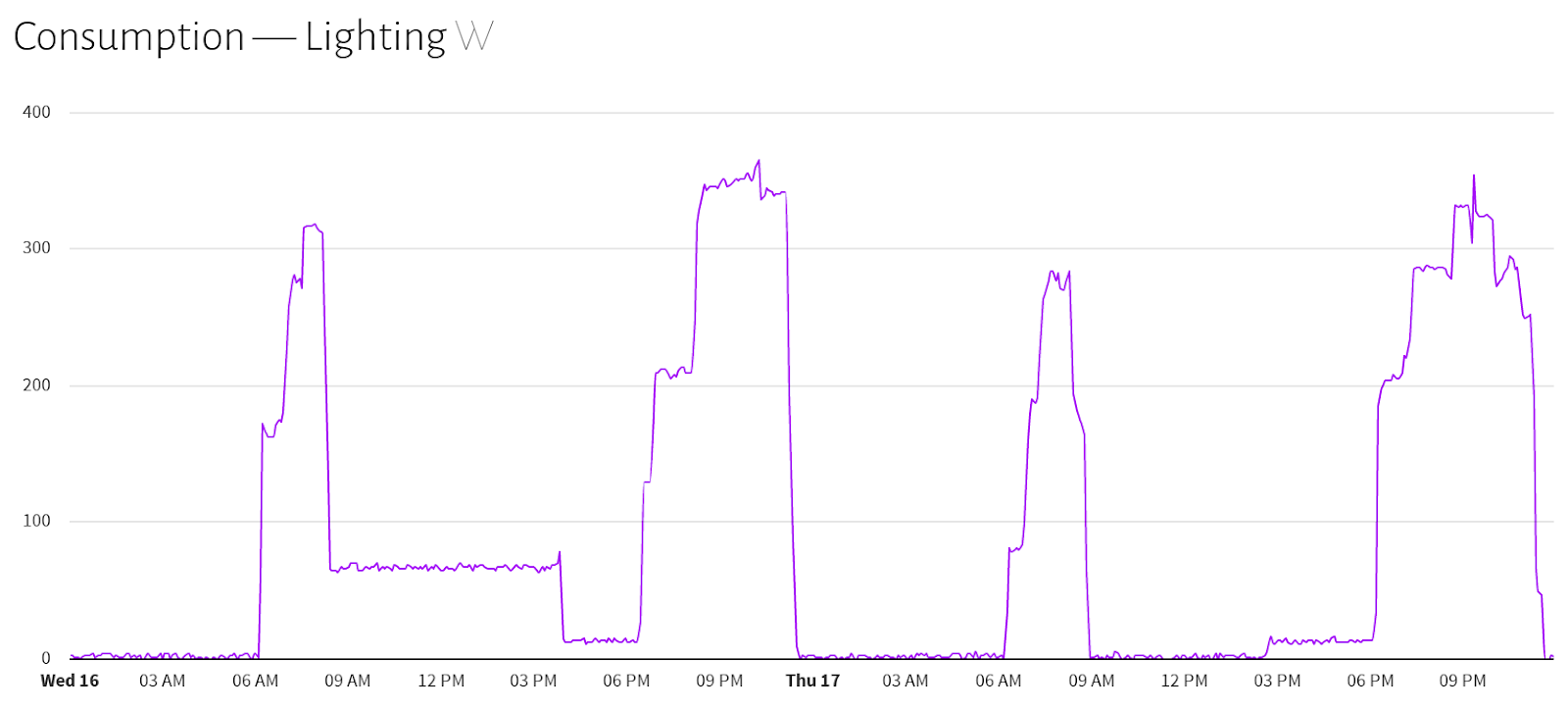
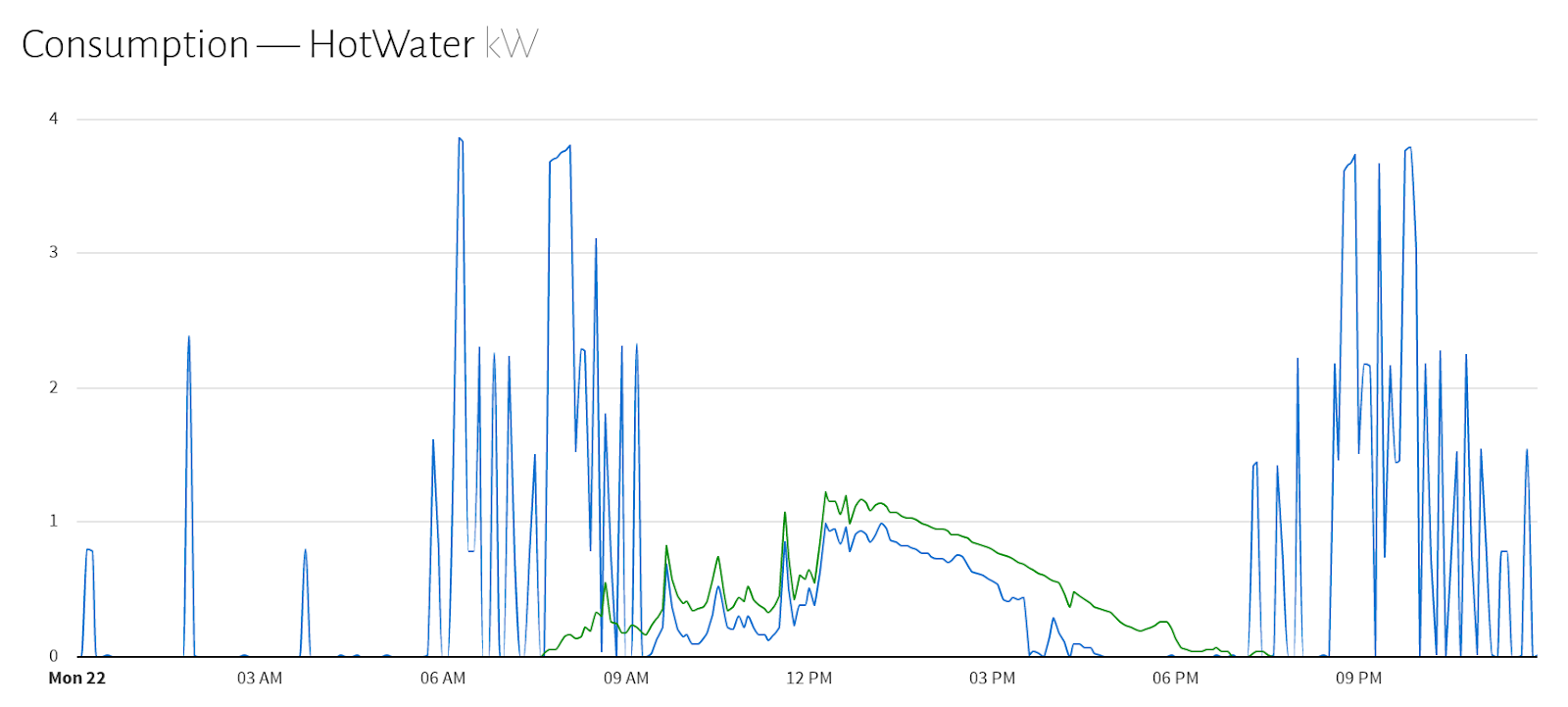
emergent is only one of many open-source “deep learning” applications that “learn” based on the examples within a prepared data set. The method of how a neural network works, as I understand it, is that it is a software able to find patterns in data after being exposed to a set of “trials” which represent the examples of how a system has been performing in a certain context represented by input variables. It looks at each of these examples, and runs through them iteratively as a set, creating what are a series of weights that drive a non-linear solution to the problem. It is iterative because it aims to find the best solution by modifying those input weights to see if that helps it get closer to the solution - but it needs to run through all the examples to gauge whether this modification was an improvement. The theory is that by doing this over and over, always following what worked best last time, the neural network gains “experience” with the data, and eventually builds a model - described mostly by the weights it settles to - that may closely describe the real world as measured by the data you collected. And it’s not something that's a “rule of thumb” or a simple calculation - it is a site-specific, non-linear solution that possibly can only be approached using this empirical methodology. I don’t know if the “Three-body Problem” is a proper analogy but I always think of the fact that while two planets in space can have their orbits with relation to each other described by a formula involving their respective masses and the distance between them, there is no such formula for 3 planetary bodies. It’s not that the orbits of 3 planets cannot be found, it’s just that it relies on circumstantial, empirical data and not a formula you can plug values into. Similarly, I believe there is no real ‘formula’ to how you use or generate energy - it just depends on the day, the time, what you’re doing, what kind of loads you have and possibly what the weather is like. We’re calling that resulting pattern your energy signature because the line of energy use - mostly a continuous time series - has that kind of shape:

Example of an Energy Signature (lighting)

Example of an Energy Signature (hot water)
 
ARM vs. x86-64 vs. GPU

So there are a few neural network applications and they run on different processors. And on top of that, there are different ‘algorithms’ that each use to accomplish the development of correlations. In our tests, we are currently using a 3-layer network Back-Propagation algorithm which suited the task, and it is one of the most standard types of neural networks. Much more complex architectures exist today and their complexity is actively handled by what seems to be a geometric growth of faster and cheaper multi-processor machines connected in clusters.

Possibly the most interesting innovation these days for deep learning has been the use of GPUs, using software frameworks that can tap the power of their parallel processing ability. Once such software framework is called CUDA (Compute Unified Device Architecture) from nVidia. This framework has been recently supported by emergent, and from the tests carried out by members of that project, the promised acceleration versus CPU is compelling - possibly a 2X - 10X multiple over a 4-core Intel processor and this performance can be achieved from a rather average gaming video card. Given the timeframe needed to develop an accurate energy signature for a building, we thought it would be good to test this out with SolarQuant.

Selecting your video card At the moment, the only GPU harnessing libraries that are supported by emergent are CUDA based, which leverages the nVidia chipsets. What seems to be one measure of expected performance is the number of CUDA “cores” on the video card. Given it was an experiment, I purchased the lowest cost nVidia card I could, namely the GTX750Ti, for around $238 NZD. This device seems to have 640 cores. To put this in context, you can see the list of different nVidia adapters and their cores here. So there are clearly more powerful units out there with several thousand CUDA cores - wow! That’s something to look forward to. Given the beast of a machine that could be built to do this job, I thought we better give these machines names to keep track. So this one is going to be called Taniwha One as an 4-core X86-64 box on emergent v7 and Taniwha Two as a 640-core CUDA computer on emergent v8.

Ubuntu 16.04 and LAMP I had the most recent version of Ubuntu, 16.10, loaded on a 3.4Ghz quad-core Intel i7 2600 machine, but when it came to compiling the special CUDA version of emergent, it did not work due to a change in the Qt5 webengine module which was needed for the application. So I installed in parallel a boot of Ubuntu 16.04, and also installed the CUDA 8.0 SDK available for download (quite large I thought at 1.9GB, but nothing major these days with broadband) from nVidia for Ubuntu 16.04 here. I followed the Build Linux directions for emergent here but with the added argument to the ./configure command:
--cuda
It chugged away for quite a while, but once it finished I set my environmental variable for LD_LIBRARYPATH using my .bashrc file:

export LD_LIBRARY_PATH=$HOME/lib:/usr/lib:/usr/local/lib:$LD_LIBRARY_PATH


And rebooted. I was then able to login and type into a command prompt window:

emergent_cuda


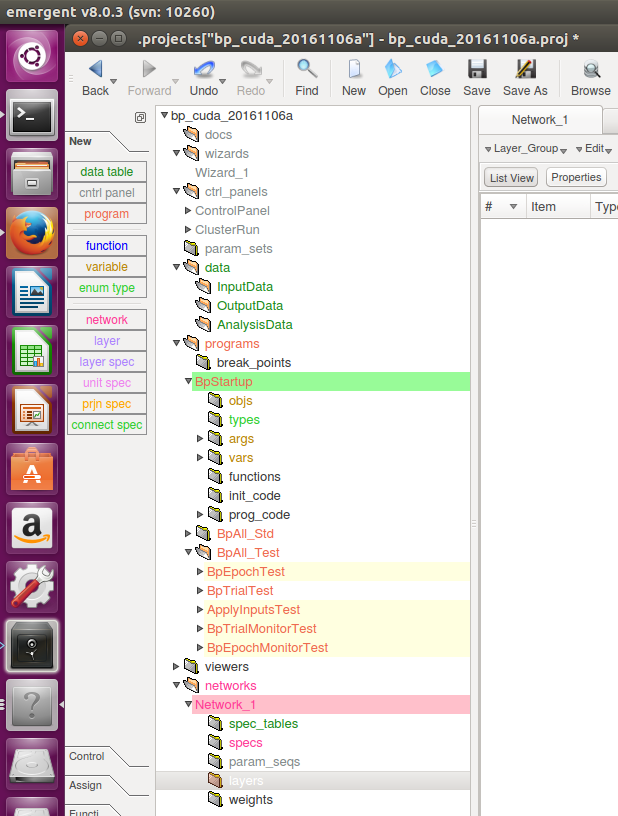
and up came the familiar GUI development toolset - but it looked pretty stylish this time compared with version 7.
emergent version 8
Emergent version 8
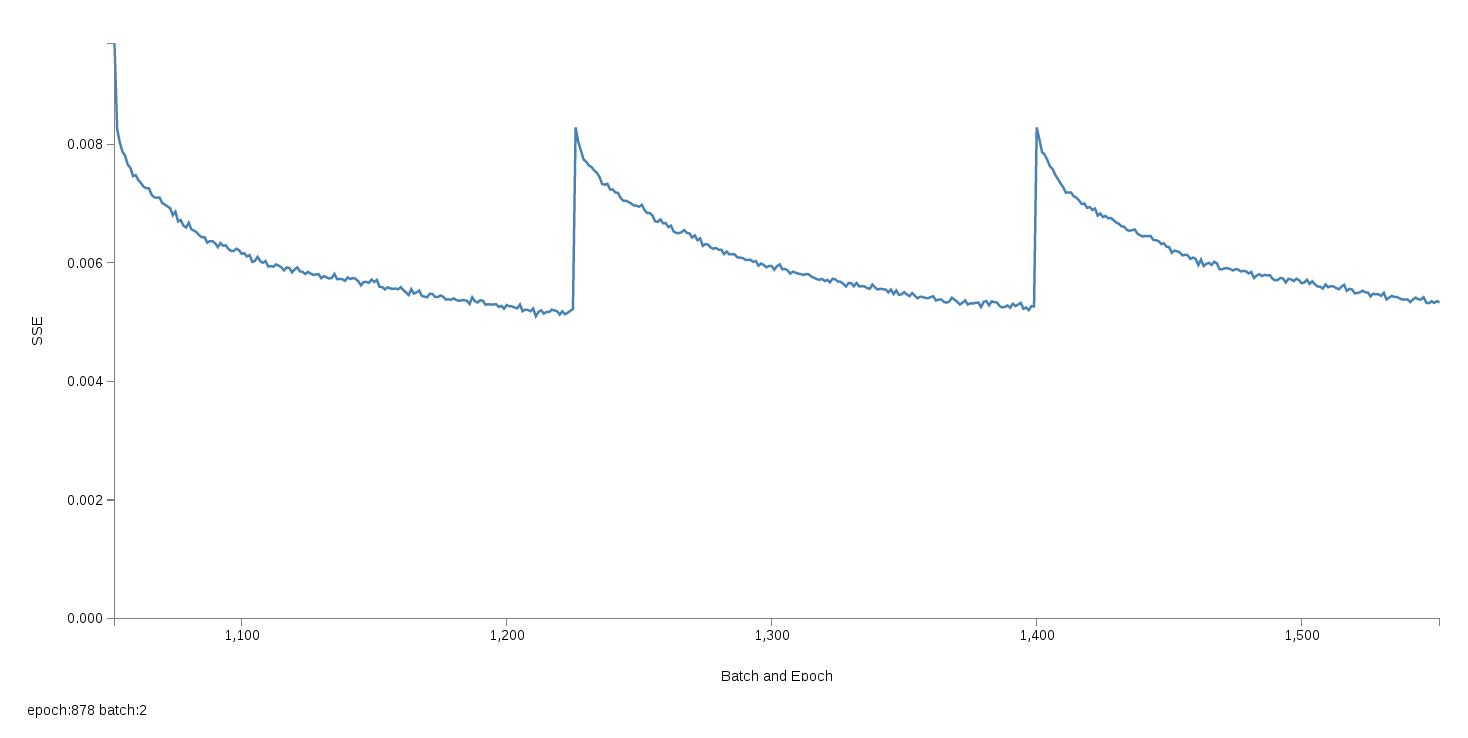
One of the nice things about emergent has been that you can do all your network design, testing and data loading using a GUI tool. The flashy and responsive visualisation of the neural network learning process shows the training process as it happens, and the falling SSE, or Sum Squared Error as it “learns”. For our application, that means that the lower the SSE goes, the better the signature we’ve developed for this SolarNode. You can see a short video of emergent running on an early network we built here but essentially what matters is that over "Batches" of "Epochs" the network trains on data sets, and develops a signature to describe that data set. This chart below shows for example 3 Batches, each with 1000 epochs, an epoch being one run through your dataset of several thousands trials. As for results of this training, you can see that while not exact, the actual (orange) versus the neural network model of that data once trained (blue) is pretty close.
3 Batches showing falling SSE as the NN learns

Training results (orange=actual, blue=trained)

Compiling emergent v7 and emergent v8 emergent has a new version (v8) but because it is still pretty new, a lot of the development SolarQuant underway has been tested on a stable version (v7.01) which runs well on both Debian and Ubuntu Linux from my experience. And because emergent can run as graphical application or via the command line, it’s a great environment to try out new correlations in a once-off manner with the GUI on your workstation or laptop, or run scheduled training sessions overnight with cron scripting via the commandline. Changing between the two versions on the same boot OS I believe is possible... but just to keep things clean and working, I have separated the two boot partitions. You wouldn't think a laptop could be powerful enough to run a massive compute intensive program like emergent, but it runs fine alongside a LAMP server on a $269 (USD) Dell Inspiron 14. I recently saw this machine however, and thought it might be a great workstation for this kind of work. And depending on how fast this GTX750Ti is, it may be something to start saving for - the GTX1060 has 1920 cores! - a multiple of 3 from Taniwha Two. Taniwha Three perhaps? In each of the emergent runtimes, you can set the number of epochs you want to run through - which is essentially how many times you go through your data set, and then batches of these epochs. You can see those 3 falling peaks in the chart above - those are batches. You can even split those batches across multiple processors I understand for further scalability, although I have not tried this yet. After each successful run, you can also output the weights matrix that your network finally got to - these small files hold the cumulative product of the training. You reference this weights matrix when you want to bounce new data off a trained network to get an "answer". Rebuilding my Back-Propagation network The only "algorithm" within emergent that can currently take advantage of the CUDA framework is the "bp" or Back-Propagation algorithm. While not the most advanced out there, it is probably appropriate for these kinds of time series experiments, and luckily that is what I've been testing with in SolarQuant. One of the cool aspects of emergent is that it contains a whole scripting language of its own which you can use to customise what you want it to do when your network project gets loaded. By passing arguments to the command line for emergent, you can tell it which program you want to run, which batches you want to run, and other important information like input data files to work with or matrix weights to start with. Because version 8 is a whole new build, the project file that I developed in v7 cannot be simply opened in v8, but has to be “rebuilt” which is essentially creating it again, defining the layers and setting the programs, using the new GUI. We’ll see how that process goes, but I intend to be able to do side by side comparisons between Taniwha One and Taniwha Two. Next post: Check in on how we’re doing with performance testing in Part 2...

Monday, December 5, 2016

University of Canterbury Motorsport (UCM)

Greenstage is proud to be supporting the University of Canterbury Motorsport team with their first full electric entry in the Formula SAE competition.  They have put together a beast of a car which is looking likely to do the business!

UCM's 2016 Formula SAE entry 
Earlier in the year Greenstage provided advice on battery pack building and the UCM team paid a few visits to make use of our Myachi Unitech battery welder (which we use for nickle or copper foil welding during pack building with 18650 or 26650 cells).

The engineering skills and quick iterations and improvements in the UCM pack designs were impressive.
UCM engineers in action
It's pleasing to see these skills and capabilities being fostered by University of Canterbury.  I would strongly recommend any budding Engineering student to get involved in a Formula SAE team if they get the chance (especially if it's electric).

Good luck to the UCM team as they head into the competition phase!

Monday, September 19, 2016

SolarNetwork guides updated

I've been updating and adding to our user and developer guides for the SolarNetwork platform. Remember the whole SolarNetwork platform is open source, so it's easy to jump in and start using it.  If you need any help or you have a project that needs development resources, please do get in touch.  We are ready and waiting to help.

Tuesday, July 28, 2015

PicoGrid Energy Audit

While there is no doubt that renewable energy has the potential to be very cost-effective and a highly beneficial option for many buildings, it is important to select a reliable project partner with your best interests at heart.

Before going solar, you need to determine the right type and size of system based on your roof size location and angle and based on your electricity consumption habits.  That way you can ensure you are investing in the best possible system for your future.

A PicoGrid Energy Audit allows you to better understand this context by providing you with a personalised assessment of your energy consumption habits and the generation potential of your roof.

We believe that the best way to promote the development of renewable energy is to make renewable energy projects more business-friendly for all project partners. Indeed, the aim is not to sell you the biggest solar PV system possible at the cheapest possible price, but to help you select the most suitable solution for your building in order to maximize the financial return (ROI) and hence reduce your costs.

What you want to avoid buying is an oversized PV system that exports excessive power to the grid, with low feed-in tariffs in New Zealand, that is just wasting money.  Better to stagger the system over time to suit your needs and to invest in appropriate energy efficiency measures to improve the financial return of the project.

This is all about knowing and understanding your energy information and this is what the PicoGrid Energy Audit will do for you.  Below is an overview of the PicoGrid Energy Audit process: 

PicoGrid Energy Audit - For optimal Solar PV project design.
For more information on PicoGrid Energy Audits, please check out the PicoGrid Energy Audit website, or contact us on 0508 742 647 or via email to book an appointment.

Friday, January 16, 2015

#LeadingTheCharge

A fleet of Tesla electric cars has just completed a length of New Zealand trip from Cape Reinga to the Bluff.  This has been a very tangible demonstration of arguably what are now the best cars in the world (electric or otherwise).

If you want to check these cars out (and a range of other electric cars), they will be on display in Auckland at Aotea Square, 1pm this Sunday.

 More info is available on LeadingTheCharge's FB page here.
Photo: courtesy 
Steve Fitzhugh
Don't miss out!

Thursday, November 27, 2014

EVolocity this weekend!

If you are in the know, you will have your tickets already, if not, get them now!

EVolocity 2014 is at Ruapuna, Christchurch, New Zealand.


Also, for those who want to know more, there is a good write up on the event here.

See you there!

Tuesday, August 26, 2014

A Distributed Electricity Company (The Future of the Modern Electricity Network) - PART 2 of 3

The volume of distributed generation is climbing (as discussed in the first post).  This trend will continue and it will ultimately reduce demand on centralised plants.  Although, due to the need for stability and continuity of supply, centralised infrastructure and plants will continue to be needed.

When combined with the need to update and renew ageing infrastructure, centralised plants have reducing revenue streams and static or increasing costs.  Hence, the cost of buying power from centralised plants must and will increase (in the US this is already happening, for a NZ context, have a look at this google search both now and in the coming years).

Net result: The price of Grid purchased electricity is going to continue to climb.

Note: I haven't talked about other drivers for electricity price increases (e.g. privatisation and the need for good profit margins), plenty of others are discussing that already.

One very good way of insulating yourself from this trend is to join the growing throng of people who generate their own electricity.

Photovoltaic (PV) panels generate electricity from sunlight
Not everyone has the financial means to purchase and install their own PV system though (even if the ongoing financial benefits make sense, you still need capital readily available to purchase the system in the first place).  This effectively creates a roadblock for many people.

There are some solutions to this conundrum.  In the next and final post in the series on Distributed Electricity I will discuss the options.

Wednesday, August 6, 2014

A Distributed Electricity Company (The Future of the Modern Electricity Network) - PART 1 of 3

Now that the NZ government has sold off a decent chunk of our generation assets, it's probably OK to let the cat out of the bag (releasing this cat is a double edged sword, read on for an explanation).
Mountains, water and electricity
(much of New Zealand's electricity is hydro generated).
Photo: courtesy Martin Stewart
To date, all of the arguments used to justify the sale of the assets fail logical reasoning. When it can be shown that the ROI of these assets vastly out strips the cost of money, it's hard to argue that selling these assets was a wise choice (the partial sale of these electricity generation asset has returned about 4.3 Billion dollars to the government).

Having said that, the government has left a key piece of information out of the story, a piece of information that can change this logical argument.  The fact is that the commercial value of these assets will be much less in the future (something the industry already knows). This will happen due to technology and market price changes on the horizon, changes that are already under way now.

What is happening is a slow but steadily increasing uptake of distributed renewable generation and this has a big effect on the electricity market.  An example of this can be seen in Australia, where the electricity spot market has recently gone negative in the middle of the day (yes, that means people are being paid to consume power!).

To be specific, the "Key Information" the government has left out of the public debate is: "As the cost of equipment for generating renewable energy continues to plummet, the value of the old industrial scale generation assets will drop."

From my perspective, this key information is the only "logical" way the government could internally justify the sale of these assets, because it means the country gets out while the capital value is high.  Of course there is also the ideological based reasoning that government ownership should be minimised, I don't think this simple reasoning can be considered logical though.  I'm also not sure what would hold more sway in the government caucus, ideology or logic?

Of course being honest about this information wouldn't have been a wise move from the governments perspective.  If you are trying to maximise the sale price of these assets (and your determined to sell), this is the last thing you want being discussed in the media...

In the next post, I'll be discussing how these changes will affect us all.

Friday, May 2, 2014

SolarNode plugin system

A long time ago SolarNode development switched from a traditional style Java application to a modular OSGi based one. One of the reasons for the switch was the premise of allowing users to easily download and use SolarNode modules without having to restart the SolarNode application. In OSGi installing, starting, stopping, and uninstalling modules (called bundles in OSGi) is fairly trivial. What SolarNode has lacked, however, was any friendly UI to allow users to browse the available modules and install the ones they want.
Finally that is about to change. The first step to enabling this feature was the deployment of a SolarNetwork-hosted software repository. There are a few open source packages out there, I ended up using Apache Archiva. Now SolarNetwork has a Maven-compatible online software repository to host its own modules, and the build infrastructure has been updated to easily publish modules as they are developed.
Browsing the SolarNetwork Repository
The next step was to make use of the OSGi Bundle Repository (OBR) developed as part of Apache Felix. OBR provides a way to resolve OSGi bundles along with their dependencies. Unfortunately, Archiva does not publish OBR metadata so I turned to another Apache project, Karaf Cave. Cave can act as a OBR proxy to a Maven repository, in which case it scans the Maven repository and generates OBR metadata files from which the OBR resource URLs point back to the artifacts in the Maven repository.

The final step was to develop some SolarNode bundles to enable configuring OBR URLs and a UI to allow users to browse the available software and install or remove individual modules. You can see the result of this work in the following demonstration:


This is a big step forward both in terms of ease of use for users and the SolarNode software development process!